Maintenance, compliance, workflow
From alarm to accountability.
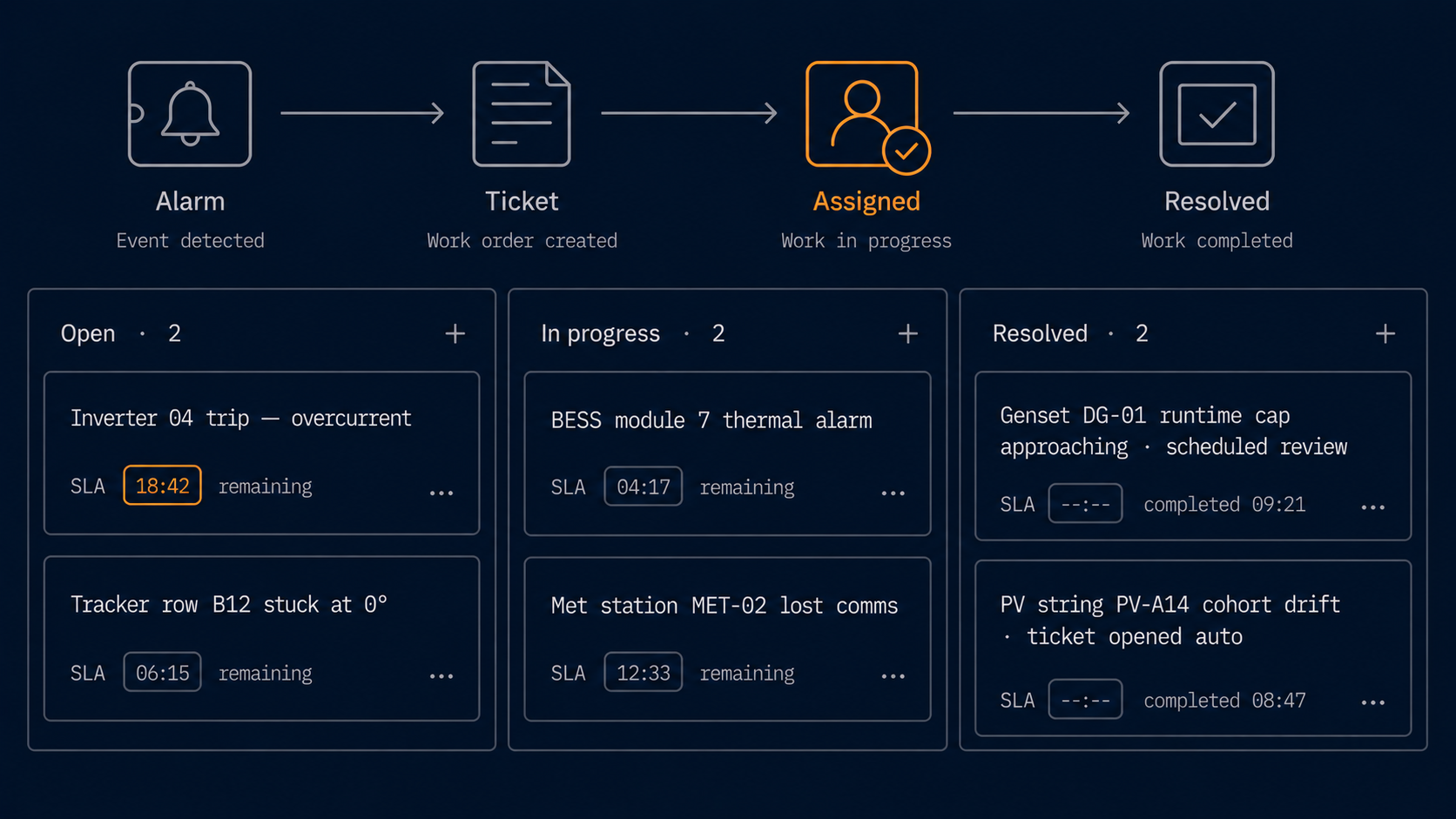
LumeTrax® Asset Manager is power-plant-native — not a generic CMMS bolted onto a SCADA. Alarms become tickets. Tickets become resolved work. The audit trail is automatic. Owner, EPC, and contracted O&M operate inside the same tenant — scoped, audited, accountable.
Mobile-ready field execution. SLA-tracked workflow. Downtime classified by attribution category — for the lender, the insurer, and the contract counterparty who all eventually ask.
Built around the actual decisions an O&M team makes — not the ones a generic CMMS was built for.
Generic asset-management tools were built for factories — repeating production lines, fixed BOMs, predictable failure modes. A 50 MWp plant doesn't look like a factory. Inverters fail individually. Trackers stick at angles. Diesel hours accrue against contractual limits. Soiling depresses output without triggering an alarm anyone notices.
Asset Manager is shaped around those realities. Alarm philosophy lives next to ticket flow. Asset registries reflect the as-built one-line. Spare parts are tied to the OEM serial they actually belong to. Downtime classification produces the report a lender, an insurer, or a contract counterparty will eventually ask to see.
The flow that decides whether an alarm becomes a problem
An alarm without a ticket is an alarm that didn't matter.
Critical alarms generate tickets automatically, routed to the right team by site, system, and severity. Tickets carry the alarm context, the historian snapshot, the affected asset, the SLA clock, and the audit trail. The same alarm rule that paged the night-shift supervisor opens the work order — there is no second system to keep in sync.
The technician's tool, not just the manager's dashboard
Tablet, phone, offline-capable.
Field technicians work from a mobile-responsive interface that runs offline when site connectivity drops. Open work orders cache locally. Photos, parts consumed, time logged, and resolution notes upload when connectivity returns. The supervisor at the office sees the same record the field technician filled in — no double-entry, no paper transfer, no Monday-morning reconciliation.
A branded native mobile app is available as an add-on for customers who want the in-app experience under their own brand (per pricing).
Ahead of the failure, not after it
Calendar-based, runtime-based, condition-based — whichever your asset class actually demands.
Preventive
Corrective
Compliance
The clock that the contract was written against
SLA breach is a state, not a discovery.
Every ticket carries an SLA clock from the moment it opens. Breach thresholds — by site, by ticket category, by contract — trigger escalation rules: notify a senior technician, then a manager, then the contracted O&M counterparty. The escalation path is configured per deployment, audit-logged per instance, and reportable per period.
Approval flows for high-value spares, third-party intervention, or scope changes route to the right authority and are recorded with timestamps. When the lender, insurer, or contract counterparty asks "did the response meet SLA?" — the answer is one query against the work-order ledger, not a forensic email search.
The registry that mirrors the as-built
Every asset, every serial, every spare — tied to the plant it actually lives on.
The asset registry mirrors the plant's as-built one-line, not a stylised tree. Each entry carries the OEM serial, install date, warranty terms, last service, next service due, and the spare-parts BOM that fits that serial. A spare-out from a regional warehouse decrements the right inventory, against the right asset, with the right accounting trail.
When the OEM warranty claim window matters, the timestamp is already in the record. When the insurer asks for spares-consumption-per-asset over a period, the report compiles from the same source the technicians wrote into. No reconciliation between an Excel spares ledger and a separate maintenance log.
The single most important field in O&M reporting
Was that hour PPA-attributable or counterparty-attributable? The report needs to know.
Every minute of downtime is classified — equipment failure, planned maintenance, force majeure, grid outage, curtailment, weather, OEM-attributable warranty event, EPC-attributable construction defect, O&M-attributable response delay. The classification is the difference between a recoverable loss and a permanent one.
Downtime reports go from "the plant was down 14 hours" to "of those 14 hours, 9 are recoverable under PPA, 3 are OEM warranty, 2 are O&M-response — here is the evidence per category."
When the OEM challenges the claim
The evidence pack writes itself, against the contract.
When an OEM warranty claim opens, Asset Manager assembles the evidence: the alarm chronology, historian snapshot before and during the event, work-order trail (response time, technician actions, parts consumed), affected-asset serial and warranty status, and time-bounded operating-data extraction. The pack matches the contract's claim format — not a generic dump.
If the claim is disputed, the same data feeds an Audit & Assurance OEM-claim review. The work has already been done; the engagement is reading and presenting it independently.
Three audiences. One source of truth.
The same plant, in the language of the person looking.
| Audience | What they see |
|---|---|
| Operator / O&M lead | MTTR, MTBF, ticket aging, SLA compliance, spare-part stockouts, technician utilisation |
| Owner / asset manager | Availability, PR, energy delivered vs. contracted, downtime by attribution category, OPEX per MWp |
| Lender / insurer | Covenant-relevant uptime, loss attribution, evidence packs, claim history, recoverable-vs-permanent loss |
Where Asset Manager fits an existing operations stack
Asset Manager can be your O&M platform. Or it can integrate with an existing one.
If you don't have a CMMS, Asset Manager is the maintenance system of record — power-plant-native by design, no generic-CMMS configuration required. If you already operate on an enterprise CMMS, Asset Manager integrates via API for asset registry, work-order exchange, and downtime-classification reporting. Standard imports cover work-order history, asset registry, spare-parts BOM, and PM schedules.
Every closed work order makes the asset more valuable.
Every classified downtime event, every consumed spare, every passed inspection, every warranty claim resolved makes the asset more valuable to its owner — and more transferable to its eventual buyer or refinancer. The platform is more useful in year three than in year one. That is intentional.
Pricing
Indicative starting points.
| Tier | Starting price | Suited for |
|---|---|---|
| Maintain Team | from $650 / mo | Single-plant O&M team. Core preventive + corrective workflow, asset registry, downtime classification, KPI dashboards. |
| Maintain Portfolio | from $1,750 / mo (5 plants) + $250 / additional plant (indicative) | Multi-plant O&M. Cross-site KPI consolidation, contractor access, SLA reporting. |
| Enterprise | quotation | Portfolio scale, complex stakeholder topology, advanced compliance, custom evidence-pack templates, regulated environments. |
Indicative starting points only. Final pricing depends on plant count, deployment shape, support tier, and integration scope.
Frequently asked questions
- Yes. Contractor access is scoped to specific plants and specific functions inside the asset owner's tenant. The contractor sees only what the owner has authorised, with full audit trail. Cross-tenant data sharing is governed by the data-neutrality policy on /security.
- Standard imports (work-order history, asset registry, spare-parts BOM, PM schedules) are supported. The questionnaire surfaces what data your incumbent CMMS exposes and what mapping is needed.
- Yes — Asset Manager can run on top of an existing SCADA via standard ingestion. The alarm-to-ticket loop is most automatic when paired with Core, because both modules share the same data model and historian. Without Core, alarms come in via API or scheduled imports rather than real-time.
- SLA clocks start when the ticket opens and pause / resume per documented business rules. Breach thresholds trigger escalation rules — to a senior technician, a manager, or the contracted O&M counterparty — with the audit trail kept for contractual review.
- Yes. Templates for lender, investor, and insurer reporting compile from completed work orders, classified downtime events, and historian snapshots. The output is auditable to source — every figure links to the underlying record.
- The standard mobile experience is a responsive PWA — works on tablet and phone, no app store install required, offline-capable. A branded native app is an optional add-on for customers who want the in-app experience under their own brand.
Asset Manager turns alarms into accountability. The siblings turn data into decisions.